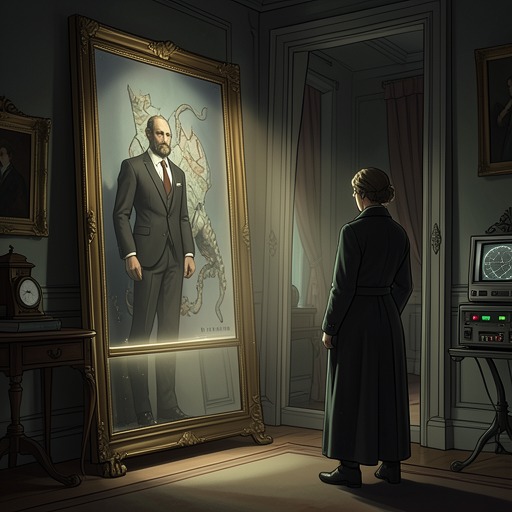
Casimir Suslowicz
The Portable DoorCasimir Suslowicz is a partner at J.W. Wells & Co. whose introduction makes a striking contrast between intimidating appearance and practical kindness. He helps Paul Carpenter find his way through the firm’s confusing building, arranges a detailed map for him, and later quietly gets a malfunctioning machine working again. At the firm’s reckoning after John Wellington Wells returns, however, John accuses Casimir of greed and questions whether he knew what Humphrey Wells had done. Casimir’s emotional response reveals a profound debt of gratitude to John, leaving his place in the firm’s history morally complicated rather than neatly resolved.
Identity and Introduction
Paul first encounters Casimir while trying to navigate a building that seems deserted and full of disconcerting features, including a stationery cupboard packed with typewriter rubbers and a door opening onto a brick wall. Turning a corner, Paul collides with one of the partners who had been present at his interview: a short, wide man with a huge black beard, whom Paul privately thinks of as Blackbeard. Casimir recovers first, a small indication of the solid, muscular build that makes him seem almost physically immovable.
Casimir greets Paul by name and asks how he is enjoying his first day. Paul mistakes him for Dennis Tanner, and a frightful scowl briefly crosses Casimir’s face, as if the error were a mortal insult. The reaction lasts only an instant: he laughs, gives his name, and offers to take Paul to Dennis Tanner’s office because the building can be confusing to newcomers. His offer is not merely courteous; he sets off briskly enough that Paul has to half skip and trot to keep up. The scene establishes a comic disparity between Casimir’s imposing presence and the ordinary helpfulness with which he responds to a new employee.
Practical Assistance at the Firm
Casimir’s help continues after this first encounter. A colleague, Tracy, brings Paul a map sent down by Cas, identifying Casimir by the shortened name. The map lays out all four floors and annotates details such as corridors, windows, fire extinguishers, and the direction in which a door opens. Its minute, clear writing and fresh-looking ink suggest a careful, specially prepared guide to a workplace whose architecture is anything but straightforward. The map turns Casimir’s earlier offer to help into lasting practical support: it gives Paul a way to navigate without having to find another guide each time.
Later, Casimir appears while Paul and Sophie Pettingell are struggling with a troublesome machine. He calls it temperamental, notes that he has urged the others to replace it, and asks to inspect it. Casimir kneels beside it like a vet attending a sick calf, listening and nodding before giving it a gentle tap. The beeping stops, the lights go out, and a clean, unwrinkled copy emerges from the rollers. The episode makes his knowledge legible through action rather than explanation. His touch is notably gentle, more reassuring pat than blow, echoing the considerate manner beneath the imposing exterior.
Allegiance and Accusation
Casimir’s most consequential appearance comes after John Wellington Wells returns. John enters with Professor Van Spee, Casimir, the Contessa di Castel’Bianco, Ricky Wurmtoter, Pip, and Dennis Tanner, then begins addressing the firm’s past. In questioning the people present, John turns to Casimir as an old friend, but pairs that intimacy with a harsh assessment: he says that many would take Casimir for too stupid to be devious, while he believes him both stupid and greedy. He asks whether Casimir knew what Humphrey had done to him. This is John’s accusation, not a confession from Casimir; the exchange raises suspicion without supplying a direct account of Casimir’s actions or knowledge.
Casimir looks as though he is about to burst into tears. Rather than answer John’s question directly, he says that he came to the country with nothing, owes everything to John, and is grateful that his good, kind friend has returned. His response reveals the emotional force of their history as Casimir understands it: John is not simply an associate or employer, but the person to whom he attributes his entire place in the country. Yet gratitude does not settle the question John has raised. The sharp difference between John’s suspicion and Casimir’s tearful declaration keeps loyalty and possible complicity in tension.
Place in the Firm’s Reckoning
After John has also questioned the Contessa and Dennis Tanner, he concludes that the immediate matters have been covered and asks Casimir and Judy to meet him in his office in ten minutes. The request places Casimir among those whose past conduct still requires private discussion, even after John’s initial confrontation. The scene gives no further answer about what Casimir knew, what he did, or how the meeting proceeds, so the appointment remains an unresolved consequence rather than proof of a verdict.
Casimir’s role is defined by this contrast between service in the present and uncertainty about the past. For Paul, he is the partner who makes an uncanny office easier to navigate and restores a failing machine with a light touch. For John, he is an old friend whose greed may have compromised his loyalty. The map, the gentle repair, and the tears do not erase the accusation; they make it harder to reduce Casimir either to a kindly helper or to a suspect. His brief appearances therefore connect the everyday workings of the firm to the deeper reckoning over what happened to John.